Plastic is everywhere. So where do you even begin?
A conversation with natasha lowe, founder of plasticus tasmania
Natasha Lowe was nearing the end of an archaeology degree at Flinders University when the world went quiet. COVID had made international travel feel like a gamble, and the prospect of a $50,000 master's degree she wasn't sure she wanted sat heavily on her. Archaeology, she realised, had always been a little self-indulgent. "It was more of a self-indulgent practice, just for me," she says. "I really wanted to find something that I felt like I was giving back to the community."
She found the Precious Plastic movement online. A global, open-source community of people building their own machines to recycle plastic at a grassroots level. The idea started small. "It grew from a little 'oh, that's cool' to 'I want to be a part of this'," she says. "And I know it could go really well in the little community of Tasmania." That instinct became Plasticus Tasmania, and it is one of the more honest origin stories you will hear, not a polished pivot or a business plan, but a person in the middle of uncertainty choosing to do something useful with their hands.
Starting with what she had
When Natasha first set up her workshop, a four by five metre space, she was collecting three types of plastic: HDPE, LDPE and polypropylene. She had chosen them carefully. Out of all the plastics, these three can be safely melted without expensive safety equipment, as long as contamination has been removed first. Keeping three plastic streams separate in a space that small proved almost impossible once the shredder was up and running. So she looked at what was actually moving through in volume.
"The amount of lids coming through, well over 50% were HDPE," she says. "I wanted to focus on the small and forgotten in our large recycling systems." Lids. The small, overlooked pieces that fall through the cracks of large-scale recycling. HDPE became her focus, and it has stayed that way. Those lids are now pressed and shaped into beautiful, functional homewares. Objects that sit in your home and quietly tell the story of where they came from.
the contamination problem nobody talks about
Spend any time with Natasha and you start to see recycling differently. Not as a virtuous act you perform by putting things in the right bin, but as a system with real humans on the other end of it. The thing that frustrates her most is not apathy. It is wishful thinking. "People seem to think that all plastic is the same," she says. "They want to believe it's simple and that it all can be lumped in together. But if it was that simple, we wouldn't have as many issues as we have today."
The contamination issue, the greasy container, the unrinsed milk bottle, the item popped in the bin with good intentions and a quietly guilty conscience, is one of the biggest problems in the system. Natasha admits she has been guilty of it herself. "How often do we look at a recyclable item, notice the grease, and put it in the recycling bin anyway, without washing it?" she asks. "We tell ourselves that the large scale washing equipment will be able to clean it, but that's not necessarily the case." A contaminated item doesn't just fail to be recycled. It can become a health hazard for the person sorting it by hand.
Taking a few extra seconds to rinse something before it goes in the bin is, in Natasha's view, one of the most genuinely useful small steps a person can take. Not glamorous. Not shareable. But real.
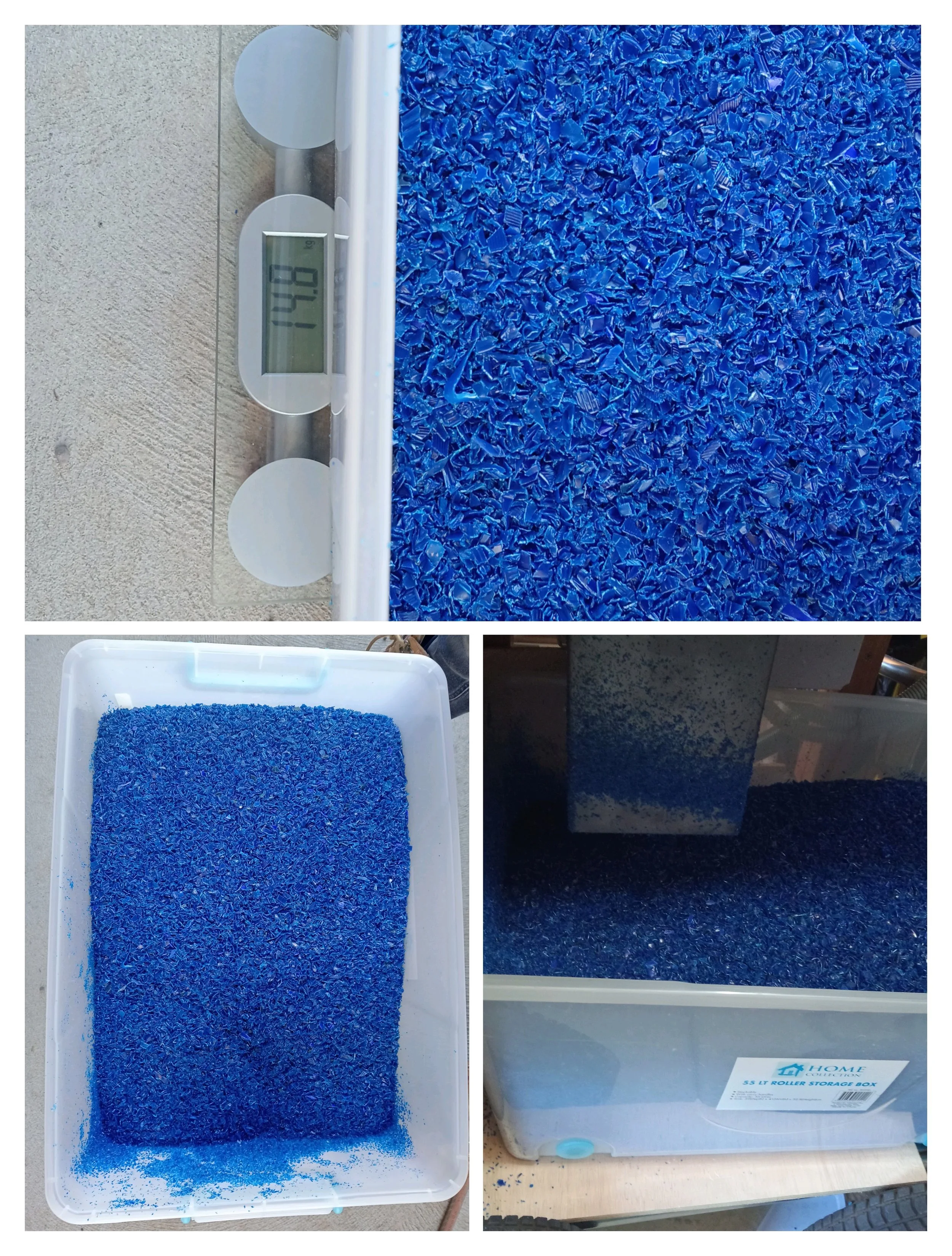
Shredded HDPE
14.8kg of shredded milk bottle lids, that will be turned into beautiful homewares.
when the scale of it feels impossible
It would be easy, talking to someone who has spent years immersed in the reality of plastic waste, to come away feeling overwhelmed. The scale of the problem is enormous. Natasha knows that better than most and she does not pretend otherwise. "Our resource management issues are huge and way too big for one person, business or community to make a noticeable impact worldwide," she says. "But if you let that fact be the end of your individual or community efforts, then we've already lost."
"You've got to start somewhere. Small steps lead to bigger and bigger impacts. So just start."
The shift she advocates for is not a behavioural one, at least not first. It is a perceptual one. Stop seeing plastic as a throwaway material and start seeing it the way you see timber or cardboard, as a resource with a life beyond its first use. "Once we start using and reusing it," she says, "we should see it as the same resource as cardboard or wood." Once you see it that way, the question of what to do with it becomes a different kind of question entirely.
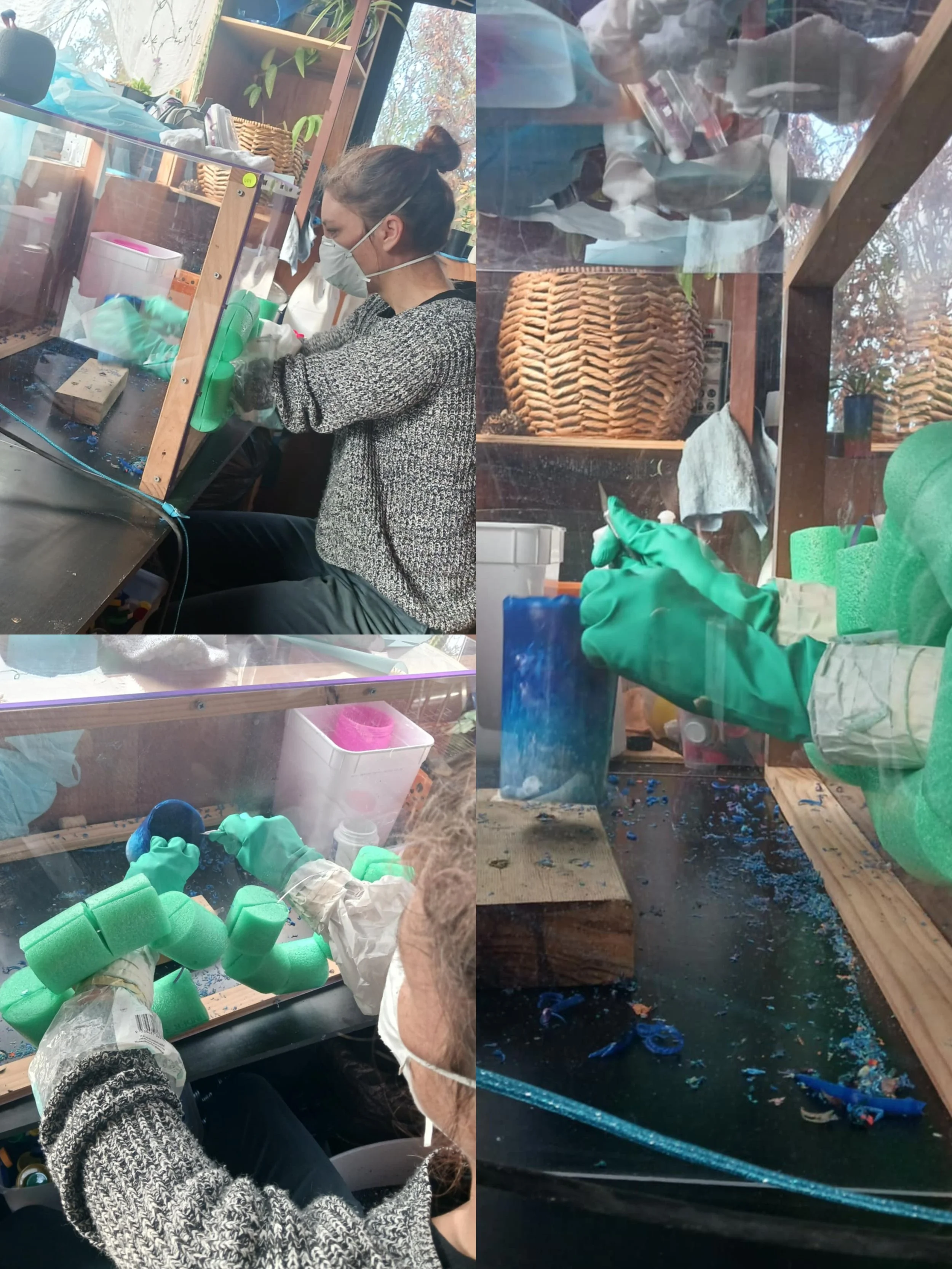
Natasha in her Workshop
Handcrafting a vessel made out of recycled HDPE.
on tasmania, and why she thinks we’re in a better poSition than we realise
Natasha is not naive about the future. She does not believe we will be plastic-free anytime soon. The economics of oil refining are too entrenched. "I see this as a minimum 100 year turnaround," she says. "It would be great if we did it quicker, but yeah." But she is also quietly optimistic about this particular corner of the world.
"If you let that fact be the end of your individual or community efforts, then we've already lost."
As the cost of transportation rises and supply chains become less reliable, Tasmania's size and self-sufficiency start to look less like a limitation and more like an advantage. "I think Tasmania is actually in a great position," she says, "because we can bring industry back and we can be more self-sufficient. We've got enough land and enough people to do it. We've just got to get there and do it." There is something deeply resonant about that idea. Community-led sustainability does not come from the top down. It comes from people in four by five metre workshops, shredding lids, pressing them into something worth keeping, and showing others what is possible.
one thing you can do this week
We asked Natasha for one practical step. Her answer was less about what to stop doing and more about where to put your power. "Drive change with what you buy, all year round," she says. "Change really happens when consumer demand changes. Make companies see that change is not only wanted but asked for, by buying items made of recycled or sustainable materials. Sometimes it's just as simple as buying toilet paper or business cards made from recycled paper instead."
It is not about being perfect. It is about being consistent enough, often enough, that it adds up. The small, considered purchase. The rinsed container. The lid saved from landfill. None of it dramatic. All of it real.
come and find natasha on 27 june
At Kinda.forward, Natasha will be there in three ways. Her stall in the Maker's Yard will have products on display, the real, physical result of lids collected and transformed. You can hold them, ask questions, see exactly what is possible with basic equipment and a clear-eyed commitment to the material. "Having a stall there means that people will be able to physically see what I've been able to produce with basic equipment," she says. "I think that's really important."
She will also speak in the Story Loft about her journey, the archaeology degree, the shredder, the slow build of something she genuinely believes in. And she will join the Small Business, Big Impact panel alongside Tom Millar from Florage Tasmania and others, to talk honestly about what it means to run a values-led small business.
"You may seem like only a small cog. And you probably are. But you never know who may come across your work and be inspired to make changes in their own lives. Encouragement feeds action."
Kinda.forward: Small Steps to Sustainability is free to attend and open to all.
Saturday 27 June 2026, 10am to 4pm, UTAS Inveresk Campus, Launceston.
Tickets available at wearekinda.com.au/kindaforward